

How to Display Fine Ceramics at Home Like a Pro
There is a real difference between ceramics that sit on a shelf and ceramics that stop people in their tracks. Knowing how to display fine ceramics effectively means thinking beyond “where does this fit” and asking instead what each piece deserves. Many collectors buy beautiful work, then crowd it onto a surface, neglect the lighting, and wonder why the display feels flat. This guide walks you through every step: preparing your space, arranging with intention, choosing the right lighting, and keeping your collection in pristine condition for years to come.
Table of Contents
- Key takeaways
- How to display fine ceramics: preparing your space
- Arranging and styling your ceramics
- Lighting techniques that make ceramics come alive
- Maintenance and care for displayed ceramics
- My perspective on treating ceramics as the art they are
- Pieces worth displaying from Thegildedcup
- FAQ
Key takeaways
| Point | Details |
|---|---|
| Prepare before placing | Choose a stable environment with controlled humidity and UV protection before arranging any piece. |
| Use negative space | A 1:1 ratio of object to open space creates focus and prevents visual clutter in any display. |
| Match light to glaze type | Warm lighting suits earthy glazes; cool lighting sharpens porcelain detail and translucency. |
| Handle with care | Always lift ceramics from the base with two hands, never by the handle or rim. |
| Treat ceramics as fine art | Fine ceramic art deserves isolated, dedicated display space, not grouping with general decor. |
How to display fine ceramics: preparing your space
Before you place a single piece, the environment matters more than most collectors realize. Fine ceramics react to their surroundings. Glaze surfaces can micro-crack from temperature swings, and UV exposure causes fading and surface stress over time. Getting the fundamentals right protects your collection before a single arrangement decision is made.
Environmental controls
Aim to maintain 40 to 60% relative humidity in any room where ceramics are displayed. Too dry and glazes can craze. Too humid and moisture seeps into unglazed clay bodies. Keep pieces away from radiators, fireplaces, and air conditioning vents, all of which create the rapid temperature shifts that ceramic bodies handle poorly.
For irreplaceable pieces or heirloom collections, consider laminated glass display cases with silica gel inserts. These are the industry standard for long-term protection, blocking up to 99.9% of UV rays while regulating interior moisture levels far better than standard or tempered glass alternatives.
Tools and materials you need
Getting set up properly requires a few non-negotiable items:
- Non-slip shelf liners or felt pads under every piece to prevent sliding and surface scratches
- Adjustable shelving that lets you change heights as your collection grows
- Museum putty for lightweight pieces on open shelves in earthquake-prone areas or homes with children
- Soft microfiber cloths for dusting without scratching glazed surfaces
- UV-filtering glass or acrylic panels for display cabinets near windows
Pro Tip: Apply the negative space principle from the start. 1 to 3 pieces spaced well create a stronger focal point than a shelf packed with everything you own. More is rarely more with fine ceramics.
Understanding what type of ceramic you own also shapes how you prepare. Earthenware is more porous and fragile than stoneware. Porcelain, while dense, has thin walls that make rims and handles vulnerable. Fine ceramic art requires isolated, dedicated display space rather than casual grouping with everyday decor, in the same way you would not hang a painting next to a paper calendar.
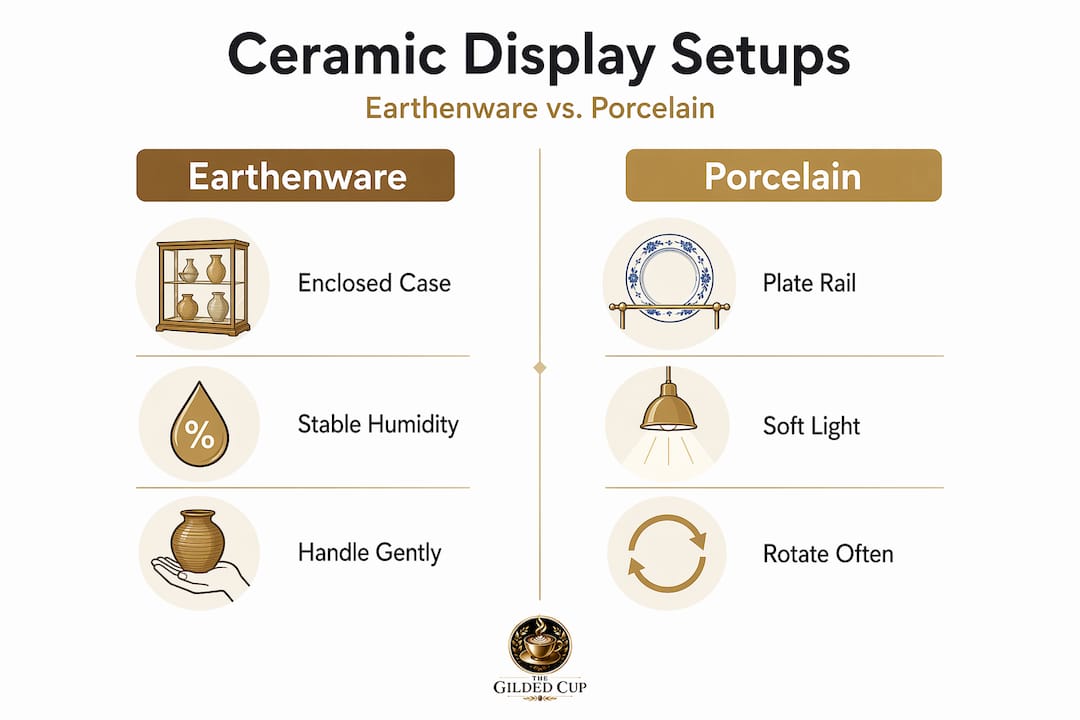
| Ceramic type | Fragility level | Recommended display setup |
|---|---|---|
| Earthenware | High | Enclosed cabinet with humidity control |
| Stoneware | Medium | Open shelves with non-slip pads |
| Porcelain | High (thin walls) | UV-filtered case or isolated shelf |
| Bone china | Very high | Display case with laminated glass |
Arranging and styling your ceramics
With your environment prepared, the actual arrangement is where you get to have some fun. The goal is a display that feels considered and alive, not like a storage solution.
Here is a reliable step-by-step process for building a display from scratch:
-
Choose your anchor piece first. Pick the most visually commanding item in your collection. This is the piece everything else will orbit. It might be the largest, the most colorful, or the one with the most sculptural presence.
-
Group by visual logic. Arrange complementary pieces around your anchor using one consistent organizing principle: color family, glaze finish, size graduation, or historical period. Mixing all of these creates visual noise. Pick one.
-
Vary height deliberately. Place taller pieces toward the back or side. Bring smaller pieces to eye level where their details can actually be seen. Use small risers or books under a cloth to adjust height without permanent fixtures.
-
Leave breathing room. The 1:1 ratio of object to open space is not just aesthetic advice. It lets each piece read as an individual object worth examining rather than part of a crowd.
-
Add supporting props sparingly. A small plant, a stack of books with a neutral spine, or a piece of raw linen can ground a display and provide scale. These elements should support the ceramics, never compete with them.
-
Step back and assess from across the room. A display that looks balanced from two feet away often looks cramped from across the room. Train yourself to evaluate from multiple distances.
For surfaces, open shelving works well for stoneware and decorative pieces you want to interact with. Mantels suit single statement pieces or tight curated groupings of three. A ceramic jug used as a display centerpiece, for example, benefits from open space on all sides so its form reads clearly from every angle.
Pro Tip: Rotate your collection seasonally. Bringing stored pieces into display rotation keeps your space feeling fresh and gives you the chance to inspect everything for new chips or crazing before it worsens.
When displaying fine china or porcelain specifically, consider plate stands or wall-mounted plate rails. These show off surface patterns that are completely invisible when pieces are stacked or placed face-down. Showcasing porcelain art vertically the way a gallery would treat a painting transforms a functional object into a composition worth studying.
A comparison of popular display surfaces:
| Surface | Best for | Watch out for |
|---|---|---|
| Open shelving | Stoneware, decorative ceramics | Dust accumulation, vibration |
| Display cabinet | Porcelain, bone china, heirlooms | Airflow, light access |
| Mantel | One to three statement pieces | Heat from fireplaces below |
| Console table | Groupings with props | Foot traffic, accidental bumps |
Lighting techniques that make ceramics come alive
Lighting is the single most underestimated element in ceramic display. The right light does not just illuminate a piece. It reveals texture, depth, and the movement in a glaze that you might miss in flat overhead lighting.
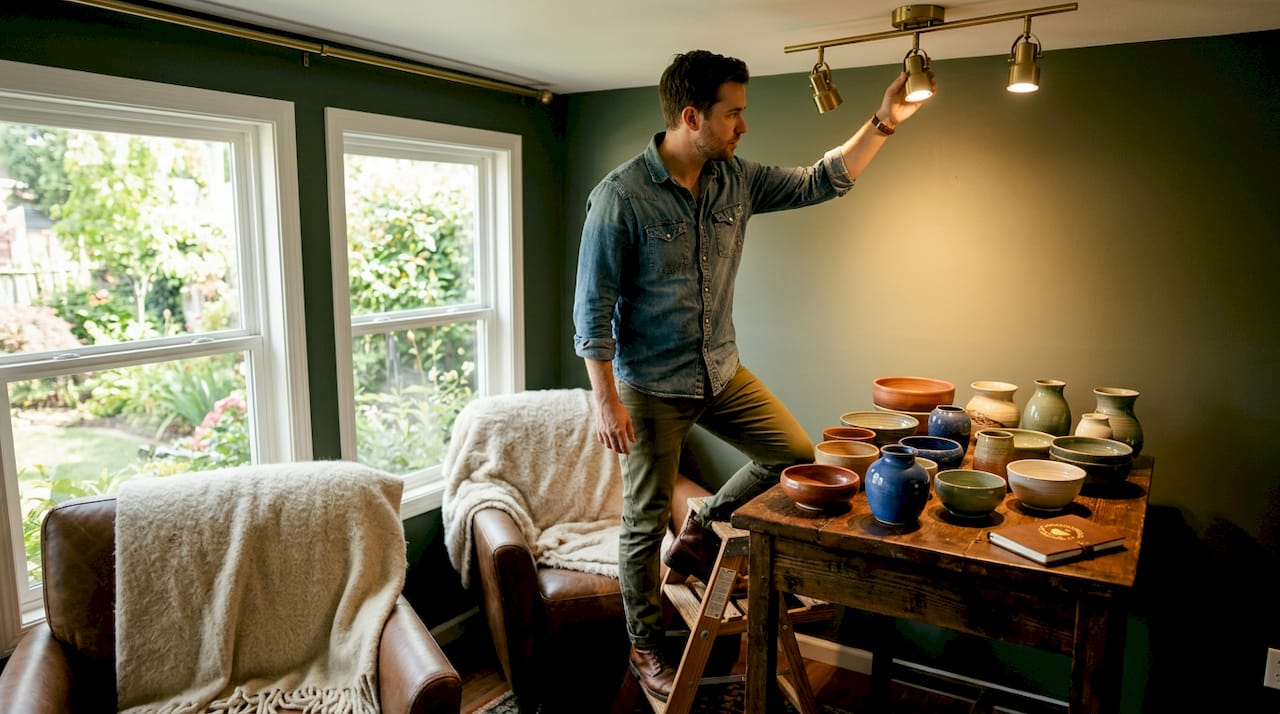
The color temperature of your light source changes everything. Warm lighting at 2700 to 3000K draws out the depth and richness of earthy stoneware glazes, terracotta, and matte finishes. It adds warmth and makes those surfaces feel tactile. Cool lighting in the 3500 to 4000K range works better for white porcelain and translucent bone china, sharpening fine detail and making surfaces appear crisper.
LED lighting is the right choice for virtually every ceramic display. LED fixtures produce minimal heat and UV output, which protects glaze color and surface integrity over years of exposure. Incandescent bulbs, by contrast, emit significant infrared heat that can stress glaze surfaces when placed too close.
Museum lighting standards offer a useful model for home collectors:
- Use fixtures with a CRI (Color Rendering Index) above 90 to see true glaze colors accurately
- Install dimmable controls so you can adjust intensity for day and evening viewing
- Position lights at a 30 to 45-degree angle to the surface to reveal texture without direct glare
- Use anti-glare shades or diffusers inside display cabinets to prevent harsh hot spots
- Layer natural and artificial light so the display transitions smoothly through the day rather than depending on overhead room lighting alone
Direct harsh spotlights pointed straight at a piece flatten its form and create distracting reflections on glazed surfaces. Angled, diffused light is almost always superior. A ceramic bloempot displayed with angled warm light, for example, shows every texture variation in the clay body that flat overhead lighting would miss entirely.
Maintenance and care for displayed ceramics
A beautifully arranged display requires a consistent care routine. Without it, even the best arrangement eventually loses its impact through dust, grime, and gradual environmental damage.
Cleaning fine ceramics correctly starts with what you avoid:
- Never use a dishwasher for displayed fine pieces unless the maker explicitly confirms it is safe. High heat and harsh detergents degrade glaze integrity and cause crazing over time.
- Avoid abrasive cloths or sponges. Always use soft microfiber or natural fiber cloths.
- Do not use vinegar or citrus-based cleaners on glazed surfaces. Use pH-neutral soap with distilled water for hand washing.
- Dry pieces completely before returning them to display, as residual moisture on unglazed bases causes staining and adhesion to shelf liners.
Handling is where damage most often happens. Always lift from the base with two hands, supporting the full weight of the piece. Handles and rims are the most common stress points and the most likely to break under load. Never pick up a lidded piece by the lid alone.
Pro Tip: Dust your displayed ceramics weekly with a soft natural-bristle brush rather than a cloth. A brush reaches into carved texture and relief detail without dragging grit across the glaze surface, which a cloth can do even when you are being careful.
For inspection, make a habit of examining each piece seasonally. Look for new hairline cracks, crazing patterns that have spread, or glaze lifting at the edges. Catching these early means you can adjust the environment before damage progresses.
Fine ceramics that are intelligently displayed with environmental controls retain both their aesthetic quality and their long-term value. Every decision around humidity, UV protection, and cleaning compounds over years into either preservation or deterioration.
My perspective on treating ceramics as the art they are
I have spent years around fine ceramics, and the mistake I see most often is the same one. People buy a stunning piece, then display it the same way they display a candle or a picture frame. They treat it as decor rather than as art.
What I have learned is that ceramics deserve a different kind of attention. They are tactile objects meant to be appreciated from all sides, not just the front face. The best displays I have seen give pieces room to breathe in all directions and position them so a viewer naturally wants to walk around them. That 360-degree engagement is what separates a meaningful display from a shelf that happens to have pottery on it.
My other strong opinion: resist the urge to fill space. I know it is tempting, especially when you have a growing collection. But the piece you place in the center of an empty shelf with nothing else around it reads ten times more powerfully than the same piece surrounded by five others. Negative space is not empty. It is the visual silence that makes the object speak.
The collectors I respect most also know why they collect fine ceramics. It is not about status or filling rooms. The benefits of fine ceramics go beyond aesthetics: you are living with work made by human hands, shaped by heat, and finished with a skill that cannot be automated. That deserves a display that honors the craft.
— Sharbel
Pieces worth displaying from Thegildedcup

If you are building or refining a ceramic collection worth displaying, the starting point is always the quality of the pieces themselves. Thegildedcup curates ceramics and fine drinkware with exactly that principle in mind: craftsmanship that earns its place on the shelf. The White Glossy Mug is a strong example of how a clean glaze finish and precise form creates a piece that holds its own in any display context. For collectors who appreciate the interplay of function and artistry, the enamel mugs collection offers durable, beautifully finished pieces that pair well with both modern and traditional display arrangements. Browse Thegildedcup’s full mugs collection to find pieces that reward display as much as use.
FAQ
What is the best way to arrange ceramics on a shelf?
Group pieces by one organizing principle (color, size, or glaze style), place taller items at the back, and leave equal open space between pieces. A ratio of one object to one unit of open space creates focus without clutter.
What lighting temperature works best for ceramic displays?
Warm lighting at 2700 to 3000K suits earthy stoneware and matte glazes. Cool lighting at 3500 to 4000K works better for white porcelain and bone china. LED fixtures with a CRI above 90 show true glaze colors most accurately.
How do I protect fine ceramics from UV damage?
Use UV-filtering glass panels in display cabinets and keep ceramics away from direct sunlight. Laminated glass blocks up to 99.9% of UV rays and is the best long-term option for heirloom or collectible pieces.
Can I display fine ceramics on open shelves?
Yes, stoneware and decorative pieces work well on open shelves with non-slip pads underneath. Porcelain, bone china, and heirloom pieces are better protected in enclosed display cabinets with humidity and UV controls.
How should I clean fine ceramics that are on display?
Dust weekly with a soft natural-bristle brush. For hand washing, use pH-neutral soap with distilled water and dry pieces fully before returning them to display. Avoid dishwashers, abrasive cloths, and citrus-based cleaners.
Recommended
- What is limited edition ceramics: a collector’s guide – The Gilded Cup
- Must-have bar glasses: the affluent collector’s guide – The Gilded Cup
- Benefits of quality home barware: the affluent host’s guide – The Gilded Cup
- Elevate Your Home Bar: 12 Must-Have Luxury Accessories - The Gilded – The Gilded Cup