

Proper champagne glass serving guide for upscale events
Even the most carefully curated champagne selection can fall flat when serving technique is overlooked. Proper champagne glass serving is not just a matter of etiquette — it directly shapes what guests taste, smell, and remember. Grip the bowl instead of the stem, pour to the brim, or reach for the wrong glass shape, and you have quietly undermined a bottle that may have cost hundreds of dollars. This guide walks you through every step: glass selection, chilling, opening, pouring, holding, and the finer points of wine etiquette champagne professionals follow at the highest level.
Table of Contents
- Gathering the essentials for proper champagne glass service
- Mastering the art of opening and pouring champagne
- The perfect champagne glass and how to hold it with elegance
- Etiquette and common mistakes to avoid when serving champagne
- Ensuring consistent quality: verification and troubleshooting tips
- A refined perspective on champagne serving etiquette and practice
- Elevate your champagne service with The Gilded Cup’s luxury serveware
- Frequently asked questions
Key Takeaways
| Point | Details |
|---|---|
| Ideal serving temperature | Serve champagne chilled between 8 and 10 degrees Celsius for best flavor and bubbles. |
| Glassware choice | Tulip-shaped glasses best preserve aroma and effervescence compared to flutes or coupes. |
| Pouring technique | Pour champagne slowly in two stages to about two-thirds full to allow breathing and prevent overflow. |
| Proper glass handling | Hold glasses by the stem with a light thumb and finger grip to avoid warming and fingerprints. |
| Etiquette matters | Raise glasses gently and incline toward guests instead of forceful clinking to protect luxury crystal. |
Gathering the essentials for proper champagne glass service
Before a single cork is lifted, the right conditions need to be in place. Proper champagne glass serving begins with two decisions most hosts get wrong: glass shape and serving temperature.
Choosing the right glass
Not all champagne glass types perform equally. The classic flute preserves bubbles reasonably well, but its narrow opening traps aroma, which means you are getting roughly 20% of the sensory experience the winemaker intended. The best glasses for champagne are tulip-shaped: wider at the bowl than a flute, tapering slightly at the rim. That shape lets the bouquet develop and rise without escaping too quickly, giving you the full aromatic profile of a prestige cuvée.
White wine glasses are actually better than flutes for tasting complexity, a point confirmed by multiple champagne houses. But for formal service at upscale events, the tulip glass is the gold standard. It reads as elegant, performs correctly, and signals to guests that you know what you are doing.
You can explore champagne glassware products specifically designed for tulip and fine stemware formats if you want to stock up before your next event.
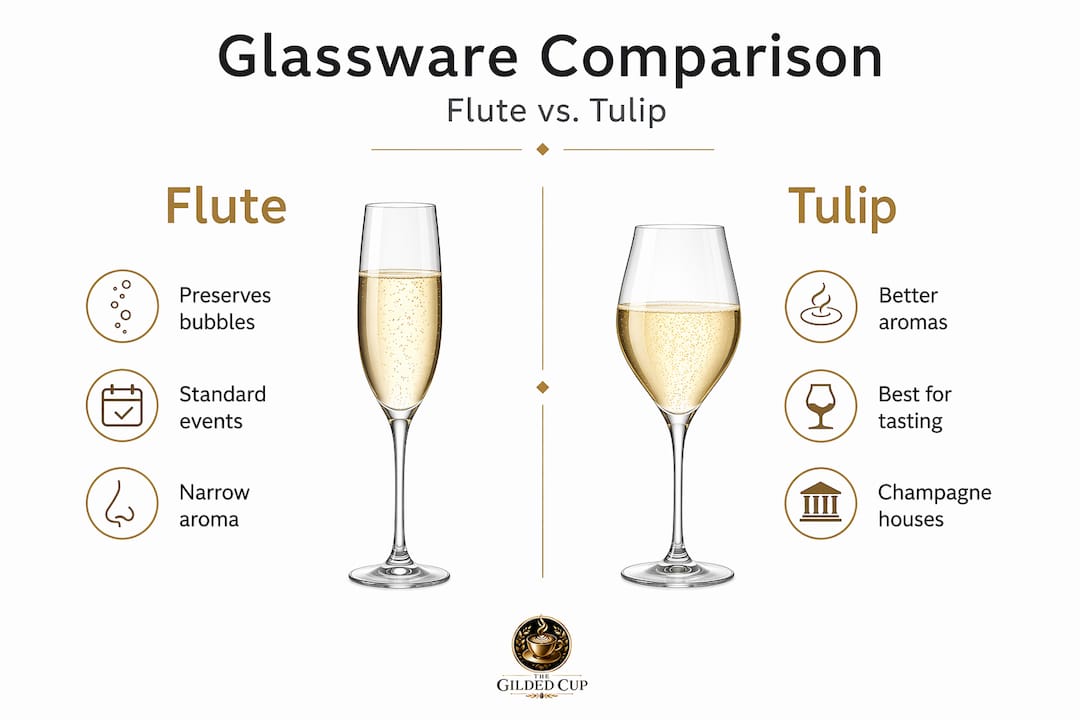
One non-negotiable: glass cleanliness. Any trace of detergent residue or dishwasher rinse aid will kill the effervescence on contact. Rinse glasses with hot water only and allow them to air dry, or polish with a lint-free cloth. Never dry the inside of a champagne glass with a cloth, as fibers introduce nucleation sites that destroy fine bubbles.
Temperature and chilling methods
Serving temperature is the single most controllable variable in champagne service, and most hosts get it wrong in both directions. Too cold and the aromas close down. Too warm and the bubbles become aggressive and the wine tastes flat.
The recommended serving range from Maison Laurent-Perrier is 8 to 10°C, achievable with 30 minutes in an ice bucket or 3 hours in the refrigerator. The Union des Maisons de Champagne advises a slightly cooler window of 6 to 9°C, with 40 minutes in an ice bucket or 2.5 hours in the fridge for professional service.
| Method | Time required | Result |
|---|---|---|
| Ice bucket (ice and water mix) | 30 to 40 minutes | Most effective, most elegant |
| Refrigerator | 2.5 to 3 hours | Reliable for advance prep |
| Freezer | Not recommended | Risks over-chilling and cork damage |
Key preparation checklist before service:
- Select tulip-shaped stemware for ideal aromatic development
- Rinse glasses with hot water and dry without cloth contact inside
- Chill bottles in an ice bucket with both ice and water (water conducts cold faster than ice alone)
- Never place a bottle in a freezer as a shortcut
- Have a clean, dry champagne towel ready to wipe the bottle neck after opening
Now that you know what you need, we’ll move on to the exact pouring technique to ensure the best champagne experience.
Mastering the art of opening and pouring champagne
A loud pop and flying cork might feel festive. At a refined event, it signals inexperience. The goal is a quiet sigh: controlled, confident, and spill-free.
Opening step by step
- Remove the foil from the top of the bottle completely.
- Keep your thumb firmly over the cork at all times during this process.
- Unwind the wire cage (muselet) six half-turns counterclockwise, but do not remove it.
- Tilt the bottle at a 45-degree angle pointing the cork away from guests and any breakable objects.
- Grip the cork and cage together with one hand and the bottle base with the other.
- Turn the bottle, not the cork. This is the most important detail most people get wrong. The bottle rotates slowly while you hold the cork stable.
- Feel the cork begin to ease out. Resist it gently until you hear a soft sigh, not a pop.
- Wipe the neck with your champagne towel and begin pouring immediately.
The 45-degree angle is not just tradition. It increases the surface area inside the bottle, which reduces pressure against the cork and gives you far more control over the release. Forcing the cork out by twisting it directly risks a sudden pressure release that sends champagne foaming out of the bottle before you reach a single glass.
Pouring correctly
Pour slowly at a 45-degree tilt, filling each glass to about two-thirds capacity to prevent overflow and allow the champagne to breathe. Do it in two stages: fill halfway, pause for the foam to settle, then top up to two-thirds. This preserves the fine mousse (the creamy layer of bubbles at the surface) and prevents a guest from receiving a glass that is 40% foam.
Pouring best practices:
- Hold the bottle by the base, not the neck, to keep your hand’s warmth away from the wine
- Do not rest the bottle on the rim of the glass while pouring
- Pour into each glass in two passes around the table, rather than filling one completely before moving to the next
- Watch the bubbles: fast, aggressive bubbles suggest the wine is too warm; no bubbles at all means it is too cold or the glass has residue
You can learn more about champagne opening and serving techniques that cover edge cases like vintage versus non-vintage pressures and sabering for special occasions.
Pro Tip: If you are serving more than eight guests, open two bottles simultaneously with a second staff member rather than rushing a single pour. Champagne poured too fast, under pressure of speed, invariably overflows.
With pouring mastered, let’s explore how to hold and appreciate your champagne glass during service.
The perfect champagne glass and how to hold it with elegance
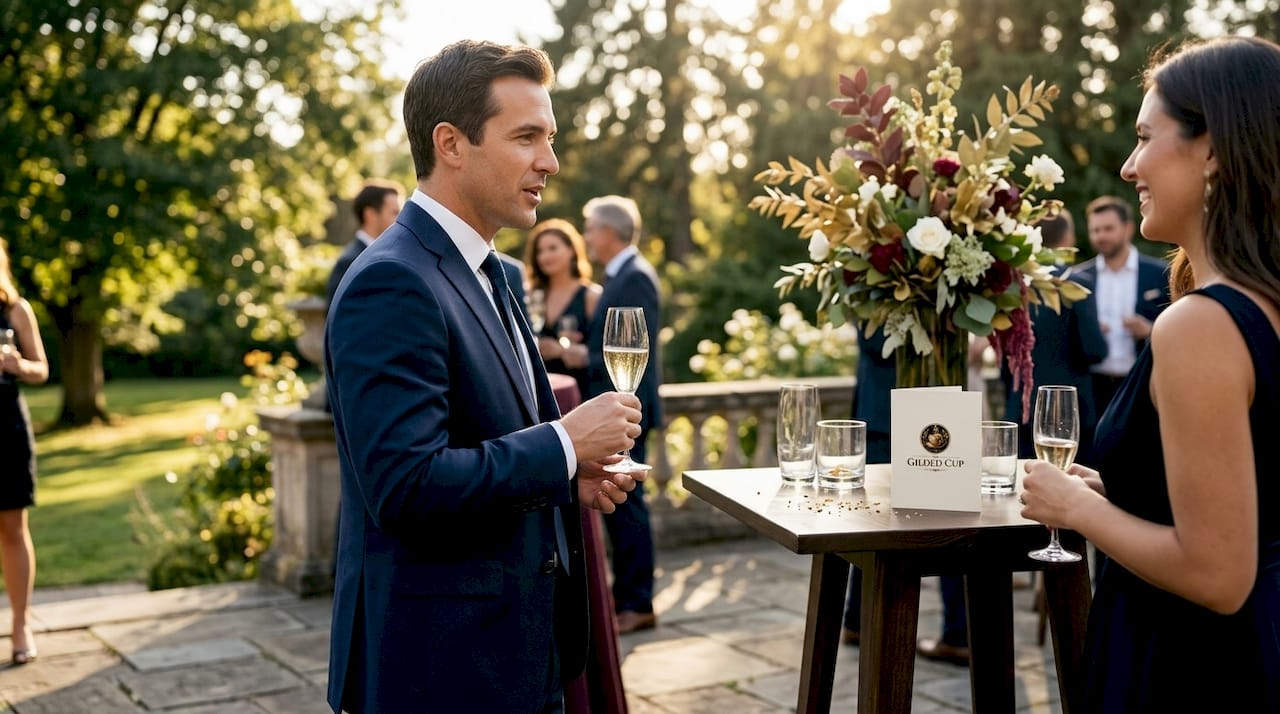
Glass selection and pouring technique mean nothing if a guest immediately wraps their hand around the bowl. The heat from a human hand raises the temperature of champagne in a tulip glass by roughly 2°C in under three minutes. At an event running two hours, that adds up significantly.
Which glass wins
Tulip-shaped glasses are the preferred format among champagne houses for both aromatic expression and bubble control. The flute concentrates bubbles visually but sacrifices nose. A standard white wine glass actually outperforms both for tasting complexity, but lacks the refinement expected at a formal event. For ideal champagne presentation, the tulip is the right call: it performs and it reads as sophisticated.
How to hold a champagne glass
Hold the glass by the stem between your thumb and index finger, with your remaining fingers resting lightly below. That grip is elegant, stable, and keeps all body heat away from the bowl.
What to do and avoid:
- Hold the glass by the stem or base only
- Never cup the bowl with your palm, even briefly
- Keep your grip light and relaxed; a tense grip looks awkward and increases the risk of breakage with fine crystal
- Avoid swirling champagne as you would a still wine. Swirling dramatically accelerates bubble loss and is considered incorrect at luxury events
- Never tilt the glass during a pour; keep it vertical and let the server tilt the bottle
Pro Tip: Brief your staff or co-hosts on stem-holding before the event. It takes one guest watching a server grip the bowl to undercut the entire aesthetic you have worked to create.
Understanding glassware and handling directs us naturally to the etiquette and common serving mistakes to avoid.
Etiquette and common mistakes to avoid when serving champagne
Serving champagne correctly at an upscale event is as much about what you do not do as what you do.
“The mark of a truly polished host is invisible effort. Guests experience pleasure; they never notice the mechanics behind it.”
The rules that matter:
- Never fill to the brim. Two-thirds is the correct fill level. A full glass has no room for aroma to collect above the liquid.
- Do not swirl. It is the most common mistake made by guests accustomed to still wine service.
- Raise your glass gently and incline it toward the person you are toasting rather than clinking forcefully. Forceful clinking chips fine crystal, and at a formal event it simply looks rough.
- Present the label outward while pouring and fill halfway first, then top up after the foam settles. This allows guests to see what they are drinking and signals confidence in your selection.
- Never pour champagne over ice. If a guest requests it, quietly offer a slightly warmer pour in a rocks glass as a discreet solution.
- Avoid stacking or pre-filling glasses more than two minutes before service. Standing champagne loses temperature and effervescence faster than most people realize.
With etiquette understood, let’s review how to control serving quality and troubleshoot common challenges.
Ensuring consistent quality: verification and troubleshooting tips
A single bottle is straightforward. Managing champagne service across a two-hour event for fifty guests requires active attention and a short troubleshooting process.
- Check temperature regularly. Use an instant-read thermometer in the ice bucket to confirm the water stays between 4 and 8°C, which keeps the bottle in the correct serving range of 8 to 10°C.
- Read the bubbles. Large, fast bubbles signal the wine is too warm. If you see this, return the bottle to the ice bucket for ten minutes before continuing service.
- Pour in two stages every time, not just for the first glass. Rushing the top-up pour during service is where overflow happens.
- Replace glasses that show detergent film. A glass that shows a ring of foam at the edge rather than fine effervescence rising from the base has residue. Swap it without comment.
- Use a hermetic stopper to preserve freshness for up to five days in the refrigerator for any opened bottles not fully consumed.
Pro Tip: Position an ice bucket at each serving station rather than centralizing all bottles at a bar. Bottles warm up in under 20 minutes on a warm evening if left on a tray. Multiple ice stations prevent temperature drift across a large venue.
Now that serving excellence is ensured, we’ll share a unique perspective on champagne etiquette few discuss.
A refined perspective on champagne serving etiquette and practice
Here is something most champagne guides will not tell you: the etiquette mistakes that matter most at upscale events are not the dramatic ones. Nobody misses a cork flying across the room. The errors that quietly undermine your event’s credibility are the small, almost invisible ones.
The flute is still the default choice at the majority of upscale events, and that is a missed opportunity. Guests at prestige dinners are increasingly knowledgeable, and serving a complex vintage in a flute signals that the host chose glass shape for aesthetics rather than experience. Switching to tulip glasses costs no more and immediately demonstrates a deeper level of care.
The bowl-grip habit is endemic, even among frequent champagne drinkers. Most people have never been explicitly taught to hold by the stem, so they revert to what feels natural. A host who demonstrates stem-holding without making it a lesson quietly elevates the entire table’s behavior.
Then there is the clinking issue. Guests consistently underestimate the fragility of fine crystal and the elegance of a gentle incline over a hard clink. A broken glass during a toast is not just a logistical problem. It interrupts the moment entirely.
The detail that separates competent champagne service from genuinely impressive service is label visibility during the pour. Turning the label toward the guest is a gesture of transparency and pride. It says: I chose this wine deliberately, and I want you to know what it is. That single movement communicates confidence in your selection more effectively than any verbal introduction.
Elevate your champagne service with The Gilded Cup’s luxury serveware
Having worked through every element of ideal champagne presentation, from glass selection to pour technique to toast etiquette, the next step is ensuring the rest of your table setting matches the standard you are setting.
At The Gilded Cup, we curate drinkware and serveware built for exactly this level of hosting. Whether you are rounding out a bar cart with the clean lines of a white glossy mug, adding contrast with our black glossy mug, or exploring our luxury tea collection for morning-after service that carries the same elegance forward, our pieces are chosen for hosts who take presentation seriously. Because the guests who notice a perfectly poured champagne will also notice everything else on your table.
Frequently asked questions
What is the ideal temperature to serve champagne?
Champagne should be served between 8 and 10°C to keep aroma and effervescence in balance. An ice bucket with water reaches this range in roughly 30 minutes.
How should I hold my champagne glass during upscale events?
Hold by the stem using a light grip between thumb and index finger, keeping your palm entirely away from the bowl to prevent warming the wine and leaving fingerprints on the glass.
Why is pouring champagne in two stages important?
Filling in two stages lets the foam from the first pour settle before topping up, which prevents overflow and ensures the guest receives a properly filled glass with intact mousse rather than mostly foam.
Is it okay to swirl champagne like still wine?
No. Swirling champagne accelerates bubble loss and is incorrect at any level of formal service. Keep the glass upright to preserve effervescence throughout the tasting.
How can I preserve opened champagne bottles longer?
Use a hermetic stopper immediately after service and refrigerate the bottle. This preserves freshness for up to five days, though quality is best within the first 24 to 48 hours.