

What Is Glassware Patina: a Collector's Guide
Most people who pick up a century-old piece of glassware and notice the subtle cloudiness or soft surface toning assume they’re looking at grime. They reach for soap and a scrub brush. That instinct is one of the most expensive mistakes in antique collecting. Understanding what is glassware patina, and why it matters, separates the collector who builds lasting value from the one who accidentally destroys it. This guide covers exactly that: how patina forms, how to recognize it, and why the right response is almost always to leave it alone.
Table of Contents
- Key Takeaways
- What is glassware patina, and how does it form
- Why patina matters for value and authenticity
- Recognizing authentic patina versus damage
- How to care for and preserve glassware patina
- Common myths about glassware patina
- My perspective on patina and what most collectors get wrong
- Explore quality craftsmanship at Thegildedcup
- FAQ
Key Takeaways
| Point | Details |
|---|---|
| Patina signals authenticity | Natural surface aging on antique glassware confirms genuine age and original condition, not neglect. |
| Pristine isn’t always better | Overly clean or uniform-looking antiques may indicate reproduction or aggressive stripping of original surfaces. |
| Patina is permanent once removed | Aggressive cleaning destroys patina irreversibly, reducing both historical and market value permanently. |
| Corrosion is not patina | Green verdigris or flaking on metal parts is harmful corrosion, not desirable surface aging. |
| Preservation beats restoration | The safest approach for most collectors is gentle handling and professional consultation before any cleaning. |
What is glassware patina, and how does it form
Glassware patina is a stable, naturally developed set of surface changes that occur over decades of age, handling, and environmental exposure. It shows up as subtle coloration shifts, soft cloudiness, slight texture variations, and in some cases tiny surface flakes or worn gilding. None of these are signs of damage. They are signs of time.
The chemistry behind patina development is more nuanced than most collectors realize. Glass is not an inert material. Over time, moisture and trace minerals in the environment interact with the silica and other compounds in the glass matrix. Patina can form as a precipitate of silica from glass solution, representing an early-stage surface reaction that, under the right conditions, stabilizes and becomes protective rather than destructive.
Beyond chemistry, handling plays a major role in patina development on glass items. The oils from human hands, combined with exposure to air, light, and fluctuating humidity over decades, gradually alter how the surface reflects and absorbs light. That is what creates the characteristic soft, warm glow you see on genuinely old glassware. It does not look like new glass. It should not look like new glass.
Here is what distinguishes patina from ordinary surface dirt:
- Depth and integration: Patina is part of the surface layer, not sitting on top of it. You cannot wipe it away with a damp cloth.
- Uneven distribution: Authentic patina follows the natural wear pattern of the object, heavier at contact points and along edges.
- Consistency with age: The toning and coloration match what would be expected given the glass type, age, and likely storage conditions.
- Absence of active deterioration: Stable patina does not flake, spread, or smell. It simply exists as a quiet layer of age.
Pro Tip: Hold a piece under a single directional light source, such as a desk lamp. Authentic patina creates a soft, uneven play of light across the surface. Dirt sits flat. Patina moves.
Why patina matters for value and authenticity
Here is the idea that surprises most people new to antique collecting: a piece in perfect, pristine condition is often worth less than one with well-developed patina. That sounds counterintuitive. It is not.
Collectors value patina because it functions as physical proof that a piece has not been altered, polished down, or reproduced. Every tiny scratch, every soft toning variation, every area of worn gilding tells you something real about the object’s history. Appraisers call it “quiet evidence.” A collector’s guide to antique glass often reinforces this point: the surface story of a glass is inseparable from its worth.
“Patina is quiet evidence that a piece has been loved and carried through time. It cannot be faked, only earned.” — Journal of Antiques and Collectibles
Lack of patina or an overly pristine condition in an antique may signal reproduction or aggressive cleaning, both of which reduce historical and market value significantly. Professional appraisers are trained to look for exactly this absence. When a piece looks too perfect, that is a red flag, not a selling point.
This matters particularly when it comes to original artistry. Many antique glass pieces carry tool marks, gilded details, or acid-etched patterns that were applied by hand. Aggressive cleaning strips these details down. Once that glassware surface finish is gone, you lose not only the look but the record of how the piece was made. The patina around those details preserves the craftsman’s touch across generations.
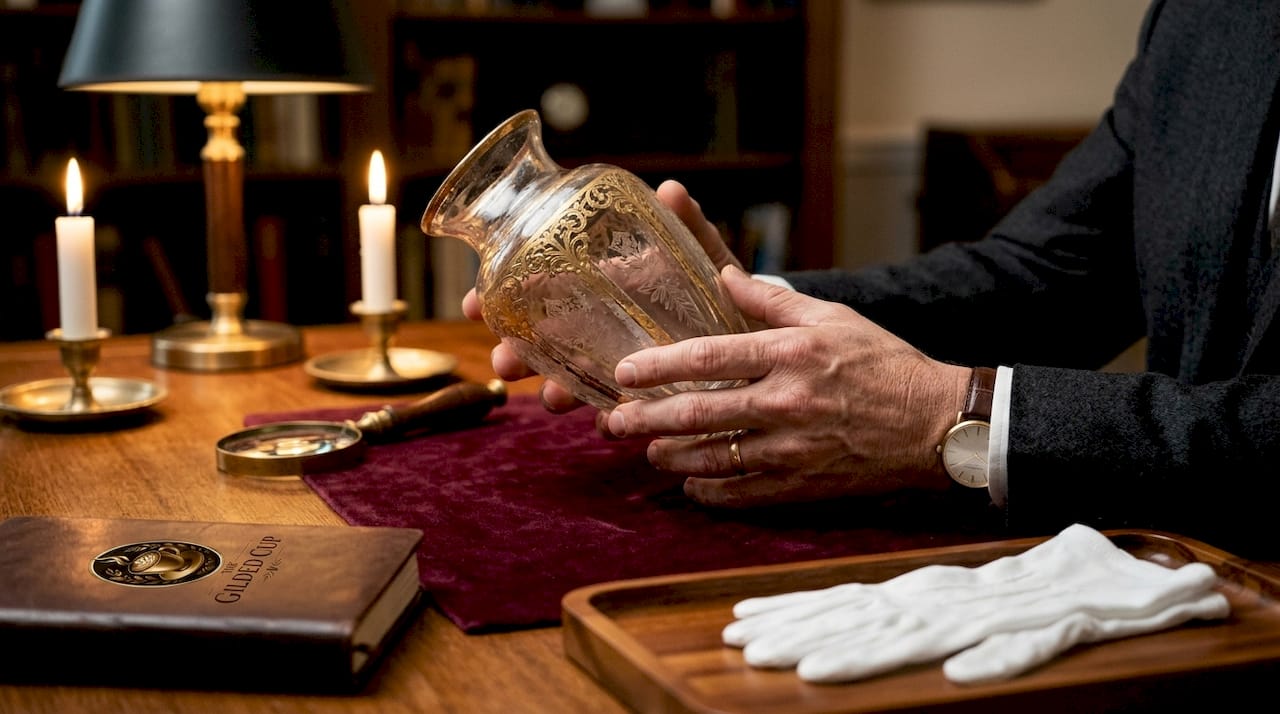
The practical takeaway for anyone buying, selling, or appraising antique glassware is to treat patina as a feature to document and protect, not a defect to eliminate. When you see it, you are seeing the real thing.
Recognizing authentic patina versus damage
Not everything unusual on old glass is desirable. Knowing the difference between aging you want to preserve and deterioration you need to address is the most practical skill a collector can develop.
Authentic patina has specific visual characteristics. Authentic antique glass shows random scratches and uneven wear patterns that are genuinely difficult to replicate artificially. These scratches are inconsistent in depth and direction, because they accumulated over decades of real use. The toning is soft and graduated, not sharp or uniform.
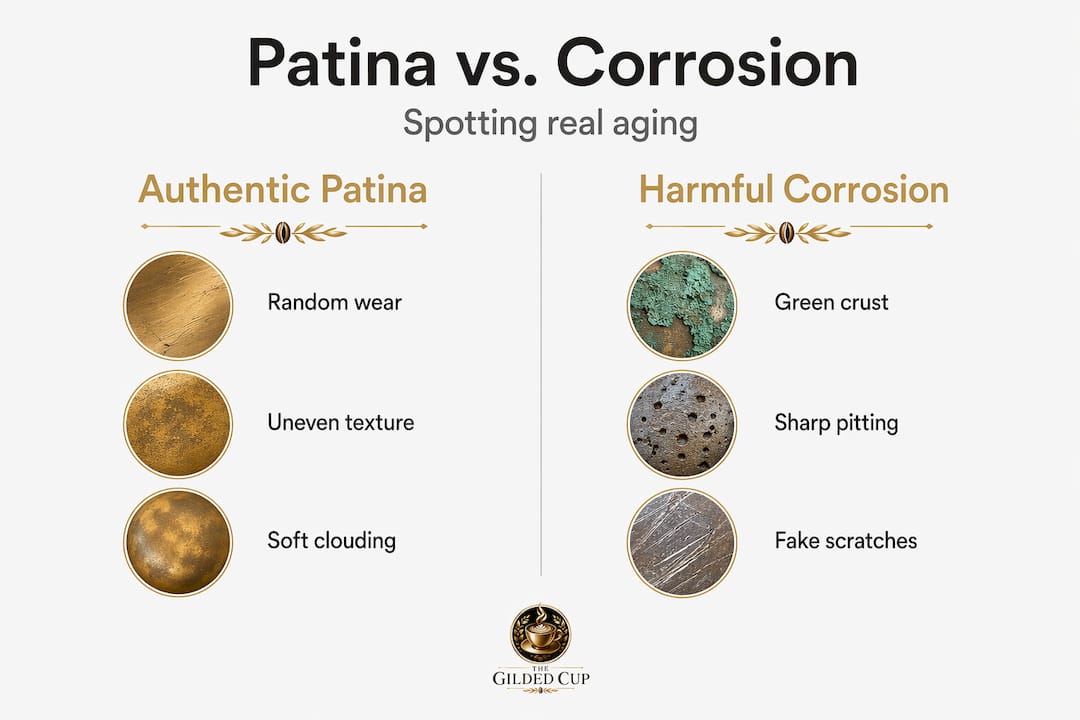
Harmful corrosion looks and behaves differently. The clearest example in glass-adjacent collecting is verdigris. Green corrosion on metal parts of glassware results from chemical reactions between copper alloys and skin oils, and it is actively damaging. Left untreated, it spreads, eats into adjacent materials, and compromises the structural integrity of metal fittings on glasses or decorative pieces.
| Feature | Authentic patina | Harmful corrosion or fake wear |
|---|---|---|
| Distribution | Random, uneven, follows use patterns | Uniform, repetitive, or concentrated in odd areas |
| Texture | Soft, integrated into the surface | Flaking, powdery, or sitting visibly on top |
| Color | Warm toning, soft cloudiness | Green, orange, or unnatural color shifts |
| Behavior | Stable, does not spread or change | Active, spreading, or accompanied by odor |
| Scratch pattern | Random depth and direction | Consistent depth, possibly circular from machine polishing |
Fakes and over-restored pieces are another category. Manufactured wear, applied artificially to make a reproduction look old, almost always fails the randomness test. Novices may confuse authentic versus artificial aging, but once you understand that real patina is the product of decades of unpredictable use rather than deliberate effort, the difference becomes easier to see.
Pro Tip: When examining a suspected antique, pay close attention to the interior surfaces and the base. Authentic glassware aging affects all surfaces somewhat equally. A piece with heavy toning on the outside and a completely pristine interior almost certainly had something done to it.
How to care for and preserve glassware patina
Preservation is the active word here, not cleaning. Your default position with patinaed antique glass should always be to do less rather than more. The risk of destroying something irreplaceable is far greater than the risk of leaving a little dust on a shelf.
When you do need to clean a patinaed piece, follow these steps in order:
- Assess before touching. Examine the piece under good lighting and determine whether you are looking at stable patina, surface dust, active corrosion, or some combination. Do not proceed until you know what you are dealing with.
- Use distilled water first. A soft, lint-free cloth barely dampened with distilled water is the safest starting point. Tap water contains minerals that can interact with sensitive glass surfaces.
- Work gently and in small sections. Never rub. Use the lightest possible pressure and work in small areas, checking after each pass.
- Dry immediately. Do not allow water to sit on antique glass surfaces. Pat dry with a clean cloth right after any damp cleaning.
- Stop before you think you should. The goal is to remove surface dust, not to make the piece look new.
For ongoing storage and handling, these practices protect patina on glass items over time:
- Store pieces away from direct sunlight, which can accelerate surface changes unevenly.
- Use acid-free tissue or clean cotton padding in storage to prevent contact abrasion.
- Handle with clean, dry hands or cotton gloves to minimize oil transfer.
- Keep pieces away from high-humidity environments, which encourage active corrosion on any metal components.
Avoid abrasive cleaning and polishing; consult professionals only if active corrosion threatens the piece’s integrity. If you see green verdigris spreading on metal fittings, flaking, or any powdery residue that was not there before, that is the moment to call a conservator, not to reach for a cleaning product. Benefits of quality home barware guides often underscore this point: knowing when not to act is as valuable as knowing how to act.
Common myths about glassware patina
Several persistent myths cause collectors to make decisions that permanently damage valuable pieces. Getting these straight matters.
Myth: Patina is just dirt and should be cleaned off. Patina is not dirt. It is a stable surface condition formed through decades of chemical and physical change. Unlike dust, once patina is removed, it cannot be authentically recreated. Removing it does not reveal a better piece underneath. It reveals a diminished one.
Myth: You can restore patina if it gets cleaned away. There is no authentic way to recreate natural patina. Artificial aging treatments exist, but professional appraisers recognize them immediately. Once gone, the historical surface is gone permanently.
Myth: A shinier piece is always more valuable. This is perhaps the most damaging belief in casual collecting. High-value antique glass is valued for its age, originality, and historical continuity, not its resemblance to new stock. Glassware aging effects that develop naturally are a feature.
- Environmental factors like humidity, temperature fluctuation, and light exposure all influence how patina develops and how quickly.
- Pieces stored in stable, low-light environments tend to develop the most consistent and desirable patina over time.
- Exposure to fluctuating conditions can accelerate corrosion rather than desirable patina, particularly where metal components are involved.
Understanding patina development in glass is ultimately about respecting what the object has been through. The surface is a record. Treat it like one.
My perspective on patina and what most collectors get wrong
I’ve handled a lot of antique glass over the years, and the single most common mistake I see is well-intentioned overcleaning. Someone inherits a beautiful piece, notices it looks “dull,” and spends an afternoon polishing it back to brightness. They feel good about it. They have just destroyed the most valuable thing about the object.
What I’ve learned is that patina is not just an aesthetic quality. It is the physical record of an object’s life. When you look at the soft toning on a century-old decanter or the worn gilding on an Art Nouveau cordial glass, you are looking at time made visible. That is not something you replicate or buy. It accumulates.
The other thing I’d push back on is the idea that glassware restoration means returning something to a “like new” state. In my view, the best restoration is almost invisible. It stabilizes what needs stabilizing, removes active deterioration, and leaves the patina exactly as found. The goal is preservation of the record, not erasure of it.
If you’re approaching a piece and wondering whether to clean it, my honest advice is: ask a conservator first. The ten minutes you spend getting a professional opinion will cost you far less than the regret of discovering you removed something irreplaceable. Patina is the glass telling you its story. The respectful thing is to listen.
— Sharbel
Explore quality craftsmanship at Thegildedcup

If understanding patina has deepened your appreciation for what makes a glass genuinely special, Thegildedcup offers a curated selection of drinkware where craftsmanship and surface quality are taken seriously. From pieces that develop beautiful character with use to those crafted with deliberate attention to finish, the collection reflects the same values that make collectors prize originality over perfection.
Browse the full mugs collection to explore options that balance artistry with everyday function. If you appreciate materials that develop a presence over time, the enamel mug is a standout for its tactile finish and durability. For something with a more expressive interior, the mug with color inside brings the kind of considered detail that collectors instinctively recognize.
FAQ
What does glassware patina mean?
Glassware patina refers to the stable, naturally developed surface changes on glass that occur over time through age, handling, and environmental exposure. These changes include subtle coloration, soft cloudiness, and texture variations that indicate authenticity rather than damage.
Can glassware patina be removed or restored?
Patina can be removed through aggressive cleaning or polishing, but it cannot be authentically restored once gone. Removing patina permanently reduces both the historical credibility and market value of antique glassware.
How do I know if it’s patina or just dirt?
Patina is integrated into the glass surface and cannot be wiped away with a damp cloth, while dirt sits on top and comes off easily. Authentic patina also shows uneven distribution consistent with decades of real use, not uniform surface grime.
Does patina increase or decrease the value of antique glass?
Patina typically increases value by confirming genuine age and originality. An overly pristine antique may actually signal reproduction or overcleaning, both of which reduce collector confidence and market price.
What causes harmful green corrosion on glassware?
Green corrosion on metal parts of glassware is verdigris, caused by chemical reactions between copper alloys and skin oils. This is active deterioration, not desirable patina, and requires professional conservation attention to prevent further damage.